

Good afternoon...
Fridays are still my favourite day of the week [just like everyone else…]
Anyways, things have been tiring lately. Or more boring, if I’m honest. My motivation for personal branding has been at an all-time low…
Well, I can blame half of it on the month itself. Everyone is on a beach or in the mountains enjoying vacations..
But if you ask me about the other half? It’s repetition. I see same sequences, and same conversations. & I know that repetition is the game that pays off. But, knowing it intellectually does not make a Monday morning any easier.
Anyways, let’s come back to work…
So far, calls volume was low because of the holidays, but people still showed up. Copenhagen, London, Israel, India.
I enjoyed almost all calls but in three separate conversations, I also watched clever people completely misread August.
Silence is never about rejection
Let’s start with the quiet narrative.
Last week a business owner in India shared his architecture with me. Eighteen months creating a foundational language model entirely from scratch. & One thing that is important here is he didn’t borrow libraries… He built it himself.
By his own estimate, twenty to twenty-five teams on earth can do what he has done.
Bootstrapped, pre-revenue and his ask was modest: between $100k and $1M, purely to rent raw GPU compute.
But he fell into the deadly trap of outreach.
Classic!
He had already cold-contacted around three hundred investors across email and LinkedIn. I asked how the market responded?
“No proper response stating that yes, I am interested or not interested.”
And he took that as the answer to all his efforts.
Man, it was August.
Everyone was Out of Office. Everyone took some actual time off, and to be honest, institutional deal flow doesn’t really wake up until September, and now it looks like everything is pretty active.
Emailing investors in August is like texting someone whose phone is on airplane mode. You might think you are being ignored, but it's entirely possible no one has seen your email….

‘As fast as possible’ is expensive
& right there is why I want to end the call.
We have all been sold this myth that a raise can happen in a flash. & LinkedIn pushes that narrative hard. Well, let me bust it for you. It doesn’t work like that, and whenever I hear the sentence, it irks me to the core.
This happened to me in August…
A founder who created an consumer app showed me his metrics, and the top line genuinely looked good.
220,000 registered users
21% one-month retention, where the industry baseline sits near 12%
Raising $20M
I let him present the whole deck without interrupting. When he was done, I simply told him that rushing to raise capital is neither the solution nor is it actually possible…
I sit on both sides of table and I know urgency gets priced instantly. When a business owner needs a round closed in thirty days, every experienced investor assumes there is a fire burning just out of frame, and they start underwriting the fire instead of the business.
His own numbers were saying the same thing more quietly.
CAC of $3.46 against an LTV of $3.49, when roughly 1.3 to 1.5 is where the business actually works.

Everyone is pricing the one risk sitting underneath every AI story right now, and it has nothing to do with whether the technology works.
The entire buildout leans on a dangerously small number of customers.
Oracle closed its fiscal year with $638 billion of future obligations.
More than half of it traces back to a single OpenAI relationship worth roughly $300 billion
That is betting the house on one tenant.
AI infrastructure is no longer underwritten like venture capital. It’s underwritten like a bank loan right now.
Things are changing more quickly than anyone can anticipate and right now, nobody is impressed by your compute anymore.
They want customer names, contract lengths, churn risk, and how many links sit between you and the companies at the top of the chain.
Everyone else is fighting over 12.5%
Look at where the money actually went last quarter:
AI took 87.5% of every US venture dollar.
Everything else in the American economy, every marketplace, every fintech, every piece of industrial software, every consumer business, split what was left.
Five years in this market, and that number still knocked the wind out of me.
Picture trying to buy a house in a neighbourhood where three tech giants are buying entire blocks in cash. You aren’t in a bad market. You are in a market where someone else stopped reading the price tags.
The rest of the picture is just as skewed.
A normal business gets a 1.6x valuation step-up, a steady climb, one stair at a time.
An AI company gets 2.2x
A late-stage AI company gets 6.6x, straight into the elevator, straight to the penthouse.
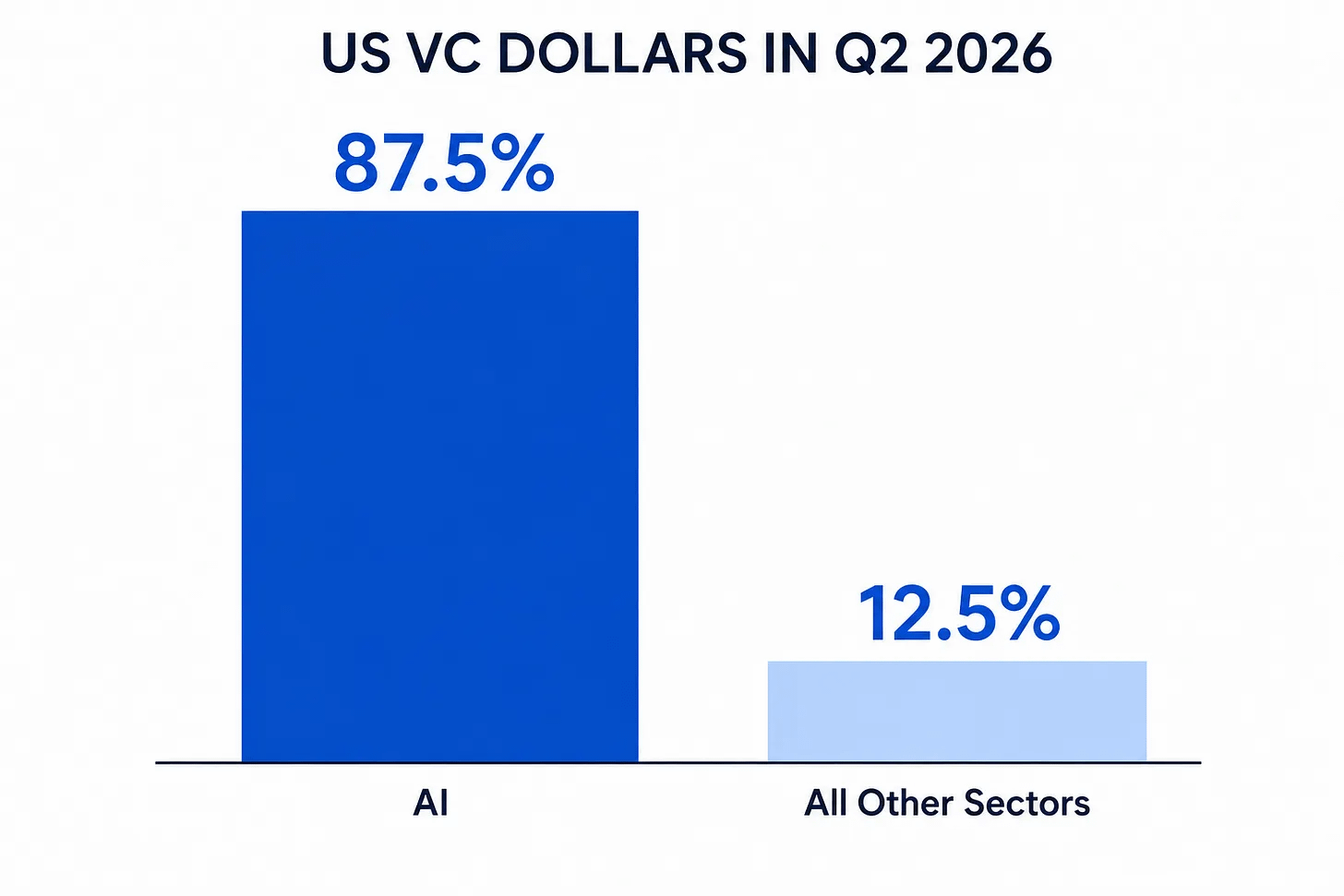
But, what we all are missing is the fact that 12.5% is the better place to be standing.
A 1.6x step-up isn’t a broken market. It’s the 6.6x that’s borrowed time, and someone will have to justify it to a board in two years who won’t find it funny anymore.
Fewer companies are competing for that smaller pool, and the investors still in it are not tourists. They chose to be there. They underwrite revenue because revenue is what’s on offer.
See for example:
Lovable raised $400M against roughly $500M of revenue
Less than a year of sales
That is what 87.5% really does. It resets the reference point for people who will never train a model in their lives.
So if you are running the unglamorous business, stop dressing it in neon. Sell the plumbing. Put your revenue, retention and contract lengths on the first three slides, and let the 1.6x market do the thing it is very good at: CLOSING
And here is a resource for you.. Check out and download the Series A investor database, fully vetted by us:
One more thing, and then I’ll let you get on with your Friday.
I asked a podcast guest something off record this month that I hadn’t planned to ask. He built a diagnostic imaging group from zero to more than forty centres, restructured a med-tech that burned through $400M, and is now building consumer neurotech. Next week he will be running across the Alps with a friend.
I asked him how he still feels excited.
Because a dream client signed this month, the biggest engagement I have ever sold, and I noticed I mostly just took it in.
He told me he stopped relying on daily dopamine years ago. He runs a few marathons a year and those are his checkpoints. He sets company goals as phases rather than numbers, always asking what the next inflection point is and which stage he wants to reach.
And that’s it.
You don’t get to feel like doing it every morning. You get a handful of real markers a year, and in between you keep the promise you made to yourself.
A raise works the exact same way. The lists, conversations and the second meetings.. Everything is like the promise and next goal that we keep setting to sign the term sheet.
Business owners who track those stay sane. Business owners who track their mood do not.
About spectup:
Capital advisory for companies raising from institutional investors (family office, VC, private equity) and for GPs raising a new fund and need intros to Limited partners