

Good afternoon…
Things have been rather busy these past few days (more than I’d like ). Well, I am back from vacation now, things are rolling in.. maybe twice or three times the way they were in August?
It’s been nice to have a month that feels a bit more… alive again. Well, September has a way of doing that honestly. I wrote in my last newsletter that July and August were slow (not completely dead this time), but the rhythm was definitely different. There were still a lot of deals happening for different people, but this time September has kicked off very strongly.


This month, I’ve been spending more time in Munich, visiting different offices for spectup and getting a better feel for where we could build the next chapter. I also bought a gravel bike, which has quickly become my new hobby & somewhere in between all of that, I managed to escape to Austria for a little vacation.
And if anyone happens to know of a good office space in Munich, let me know. I’m still looking. 👀
This week it was quite fun and busy at Bits & Pretzels. I’ll write a detailed newsletter on this next week & by the way, next week I’ll be in Berlin recording five podcast episodes.
Founders who were waiting until September are back. Investors who were travelling are back. LPs are back at their desks, funds are closing, rounds are moving. Conversations that were just stuck in limbo throughout July and August suddenly have a very different energy. A bunch of follow-up calls, all the relationships that were moving slowly and all that, have suddenly started to lock in. Every time I open LinkedIn, I see another startup coming out of stealth or someone closing a deal.
And honestly, it feels so great.
This is the most active window of Capital Raising:
I have had this conversation with founders several times over the summer. September and October are always some of the most active windows for getting rounds moving and actually closing them. The deals are telling the same story.
Mistral closed a €3 billion Series D this month, the largest private technology fundraising ever completed by a European company, taking the company to a valuation of roughly €21 billion.
Exein raised around €234 million and became Europe’s newest cybersecurity unicorn.
Euclyd raised more than €200 million to build the infrastructure underneath AI inference.
EnduroSat raised $205 million to scale satellite manufacturing across Europe and the US.
Open Cosmos announced €300 million of financing.
And it’s not just Europe. In the US, Positron raised $875 million at a $5 billion valuation for inference chips, Temporal raised $550 million, Cornelis Networks raised $205 million and Profound raised $180 million.
This is just a bunch of startups that I wrote. The list is insane and huge.
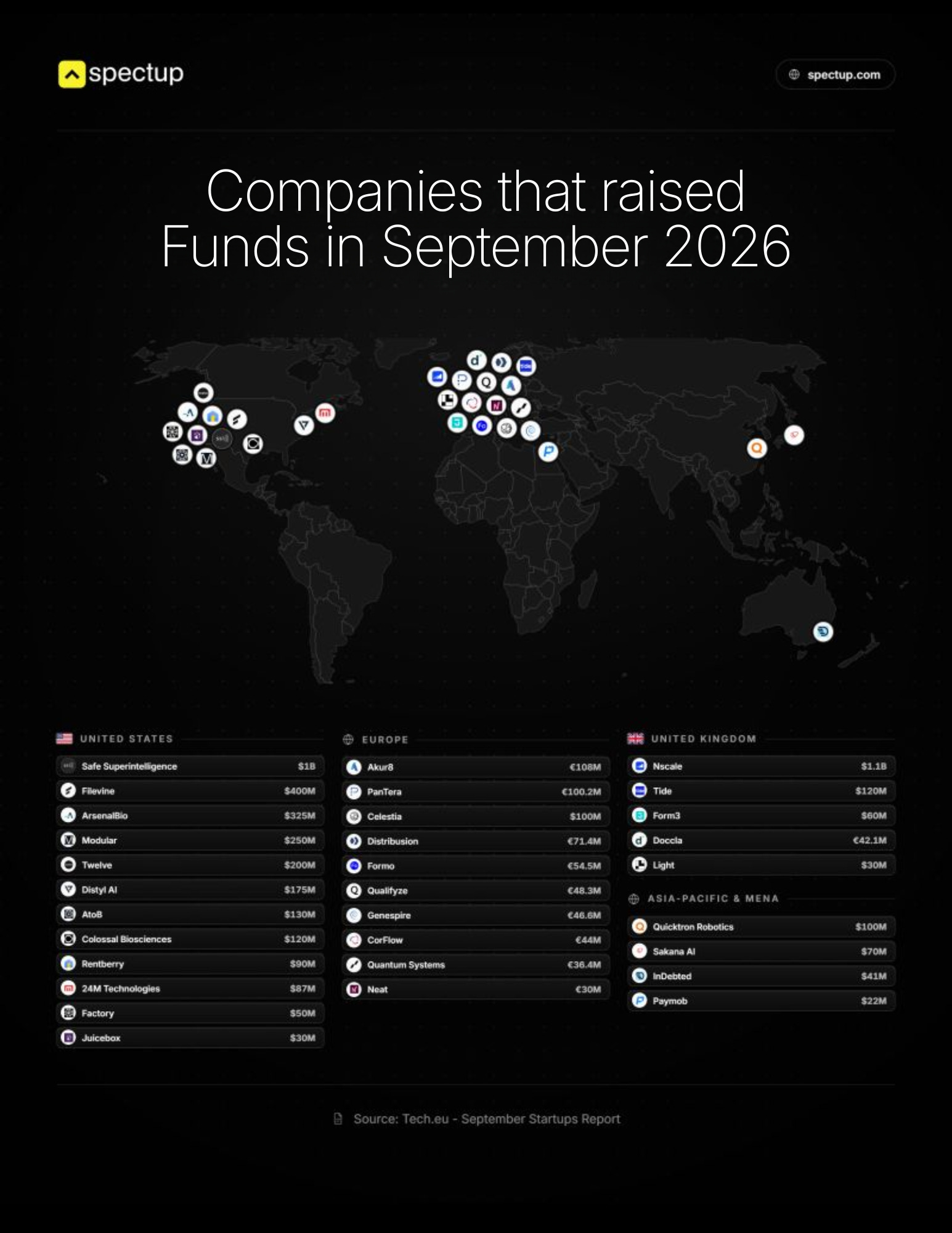
Signals in Capital Raising:
I find the signals particularly interesting right now. Every single deal is telling us where investors are willing to put their money and how LPs are prioritizing funds based on specific niches.
This is simply not another AI funding cycle. Instead, it is becoming much more about infrastructure deals, defence, and physical AI. Hardware is having its moment again. So, apparently, everything that can show real evidence is back.
AI is also becoming more than just another venture category. It is turning into a whole interconnected class tied to energy, power, defence, and data centres.
Silicon Valley is having a hardware moment. Europe is having an infrastructure moment. And the two are starting to look surprisingly similar.
Machine Fund launched by a16z
I am particularly so excited to see the physical and machine era coming back. It feels like the hype around AI is finally starting to settle, and people are going to see actual versions of the products being built.
And the best signal of that, for me, was a16z announcing its $1.1 billion Machine Age Fund, built specifically around the physical infrastructure of AI: chips, memory, networking, data centres, robotics, and everything required to make intelligent systems exist in the physical world.
Well, if you’d ask me, I would say skip everything else. This signal is everything.
You are looking at the next 10 years, and the fund that everyone wants to have on their cap table has clearly shown where its focus is going.
Now, a lot of serious money is asking a different question:
What does the model actually need to run?
Compute, energy, semiconductors, data centres, robotics, defence, security, manufacturing, networks, physical infrastructure. That’s where a lot of the genuinely interesting capital is moving.


Europe has a particularly interesting position here. The capital itself is becoming more strategic. Europe is trying to build the financial infrastructure around the companies it thinks it cannot afford to lose & I think that’s going to matter a lot in Q4.
September and October are the months when relationships built before and during the summer finally get the chance to turn into actual allocation. The conversations are happening. The investment committees are meeting again and people are figuring out what they still have to deploy.
But there’s a big difference between the market moving quickly and your fundraising needing to move quickly. I’ve been seeing that difference on my calls.
Insider signals from my calls:
One of the more interesting conversations I had recently was with a founder raising around $20 million. The company was ambitious, and some investors were showing interest as well, so clearly the early commitments were being used to create urgency and FOMO. But there is a clear line between creating FOMO and showing desperation.
I understand the thinking that if someone has already committed a million, maybe the next investor thinks, “Okay, other people are in. I should move too.” That’s how FOMO works, and yes, you should manufacture momentum.
I keep coming back to this because I’ve said it before, and I’ll probably say it another hundred times: Investors can smell urgency.
They know when a founder actually has leverage, and they also know when the runway is getting short and the round suddenly needs to close in three weeks.
The problem is founders sometimes confuse speed with strength. They are not the same thing.
If you tell an investor “we need to close this round as quickly as possible,” they don’t automatically hear ambition. They might hear a company that needs the money.
And if you have given that signal to the investor, he might think that think the company needs the money more than they want the deal, your negotiating position changes. That’s expensive.
I had another conversation where the founder wanted to move fast because the story was good and the market felt ready. The problem was the business still had things that needed to be proven. That’s where rushing gets dangerous. You’re not just accelerating the fundraising process, you’re potentially accelerating the investor’s discovery of everything that isn’t ready yet.
There’s a huge difference between “we have strong investor interest and want to close this round efficiently” and “we need the money in three weeks.” The first creates momentum and urgency but the second creates questions.
Why three weeks?
What happens if it takes six?
What happens if the lead wants another month of diligence, or another customer reference, or wants to see the model again?
Bridge rounds are coming back
The second thing I’m seeing more of is founders becoming much more open to bridge rounds, and I actually think that’s healthy. For a while the conversation was always “we’re raising our Seed” or “we’re raising our Series A,” everything had to fit neatly into the next round. But the market doesn’t always work neatly.
I recently had a conversation where a bridge was being considered specifically to build more revenue and give the company a stronger position for a later Seed or pre-Series A. That’s very different from raising a bridge because the company is running out of money. It’s being strategic and the investors also love seeing that momentum.
If you can say “give us six more months and we move from this position to that one,” the bridge has a purpose.
If the answer is “we just need enough to survive until someone gives us a Series A,” that’s a different conversation.
I’m also seeing more activity at the early end. Pre-seed isn’t dead, if anything AI is letting some founders reach meaningful technical milestones with dramatically smaller teams and less capital. Dealroom has already flagged fresh September pre-seed activity, from AI event planning to AI-enabled professional services.
But there’s a catch. Pre-seed is increasingly becoming what I’d call “seed for the founder.” You still have to think about the next institutional round.
What does this money prove?
What does the next round look like?
What investor comes next?
What milestone justifies the next valuation?
The fact that you can raise earlier doesn’t mean you can ignore what happens later.
AI as a threat…
This is probably one of my favorite topic so far. There’s a huge debate happening right now about whether AI is going too far, whether we need regulation, whether it becomes a threat, whether governments can keep up, whether the technology should slow down. I understand all of that, but from where I sit there’s another question that matters just as much:
What happens if the technology keeps moving regardless?
Because honestly, right now a lot of capital is already preparing for that world. Investors are funding the infrastructure, companies are building the hardware, governments are thinking about sovereignty.
Europe is talking about compute capacity. The US is pouring money into chips, data centres and energy. China is pushing its own AI stack. And founders are building businesses around every layer of it.
So I don’t think the answer for founders is “AI is the future.” Everyone already knows that. The interesting question is what part of that future you’re actually building. That’s where the money is getting selective.

One final thought on Europe…
I am bullish on European capital and talent, but at the same time, there are a few things I really enjoy debating. The more I dig into it, the more I come across new regulations, new momentum, and new developments that genuinely catch my interest.
Europe doesn’t have a shortage of money. We’ve talked about this before. Europeans save enormous amounts and European institutions control enormous amounts of capital. Pension funds, insurers, sovereign investors, large asset owners, they have the ability to move markets.
The question is where that capital gets deployed?
That’s why I keep watching what happens when public and institutional capital starts sitting alongside private investors. Look at the Scaleup Europe Fund, €5 billion being built around European scaleups, particularly deep tech and strategic technologies, public and private capital sitting together. Then look at Mistral, where the same week Europe is debating AI sovereignty, European-backed capital is participating in Europe’s biggest private technology round. That’s not an accident.
I think there’s a much bigger conversation coming here. One large sovereign or institutional allocation can change an entire category. It can change which funds can raise, change which companies get follow-on capital & can change whether European founders need to leave Europe to find growth capital. It can change what LPs believe is investable. Eventually it can change where the next generation of European companies gets built.

We have startups, founders and technology. We have capital. The question is whether we connect all four at the right moment, and right now September feels like one of those moments. Everyone is back. The funds are back, investors are back and the founders are back. The deals are moving.
Now the question is who actually came prepared for it.
That’s me for this week. What do you think?
About spectup:
Capital advisory for companies raising from institutional investors (family office, VC, private equity) and for GPs raising a new fund and need intros to Limited partners