

Hey Folks,
I got back from vacation last week and honestly, things were piling up. Switch off for a week and the inbox treats it as an invitation. Founder calls, investor replies, podcast guests to line up. All of it at once, so last week became one routine: morning, coffee, straight into digging out.


Before anything else, I thought to send something free for you.
Our AI capital-raising framework
We built a lead magnet, and it is the exact framework we run at spectup. How we actually use Claude to raise capital (and it’s not some generic the “AI writes your deck” version). It has the real workflow:
How we research investors
Spot who is actively deploying
Draft outreach that gets replies
Prep founders for the calls
Keep a full pipeline warm without losing our minds
Same process behind the raises we run every week. We wrote it down. It is yours.
Insider Secrets (All these signals are from whole week calls):
I take a lot of founder and investor calls in a normal week. That gives me an early read on the capital markets, the real signals, before they show up in any report.
1. The SAFE-versus-priced line is hardening around $3M.
Right now about 64% of seed deals under $3M are getting done on SAFEs. Above $3M, that falls to roughly 24%.
If you are raising near that number, the instrument is not a toss-up anymore. Below three, the market wants speed and a SAFE. Above three, it starts asking for a priced round.
2. The type of money beats the amount
I spoke with a founder this week whose co-founder had a large exit and could have funded the whole round himself. He is not doing it. Cap-table concentration, portfolio exposure, and the plain truth that the right outside investor brings more than a wire.
His line stuck with me: it is much more about the type of money than the money itself.
3. AI is creating buyers that never existed
One team I talked to built precision video translation for regulated industries. The story was not the tech. It was that whole markets never localized their content at all, because the math never worked. Now it does. They are creating customers who were priced out last year, not taking a competitor’s.
So, the takeaway is: Look for the market that could not afford the old way, not the vendor you can undercut.
4. Reshoring is turning into a funding theme
Three calls this week, three unrelated sectors, one pattern: solar moving out of China, drug trials coming home, defense hardware built domestically. Supply-chain repatriation stopped being a policy headline and became a line in the pitch.
The Bigger Picture of Capital Ecosystem
A few things moving outside my inbox that are worth two minutes.
1. Google is spending like the AI race is existential
Alphabet guided to $175 to $185 billion of capex in 2026, most of it AI and data centers. That single year is more than its previous three years of capex combined.
2. And it is not just Google
The five biggest US cloud players are on track for roughly $660 to $690 billion of infrastructure spend this year. The line to sit with: they all say they are supply-constrained, not demand-constrained.
The hard part right now is building capacity fast enough
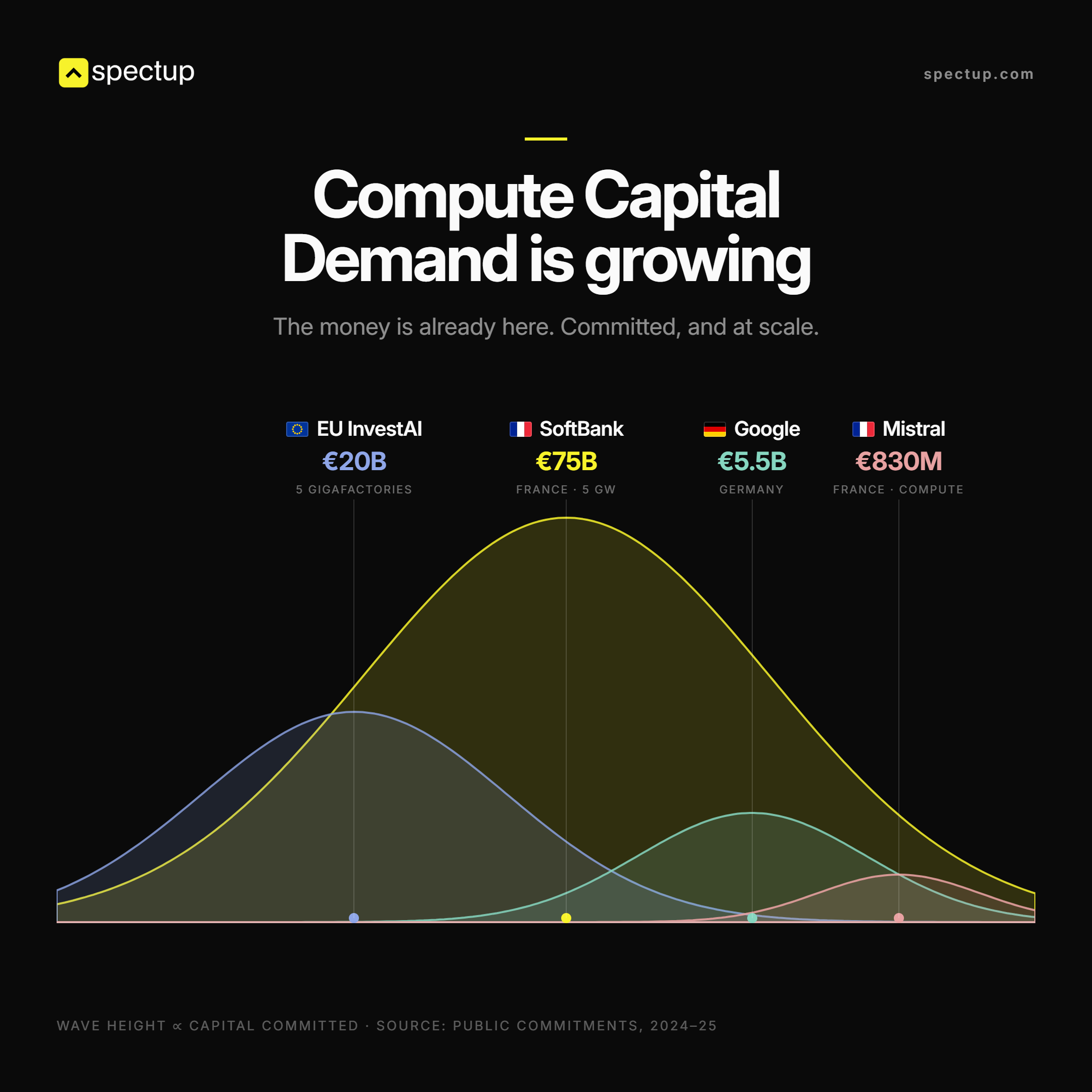
3. China shipping a frontier open model is the new normal
Moonshot is rolling out Kimi K3, a 2 to 3 trillion parameter open-weight model that early reports expect to rival Anthropic’s best. Between DeepSeek, Z.ai, and Moonshot, capable open models now land on a steady cadence.
If you build on AI, the cost of frontier-level capability keeps dropping, and that changes both your build-versus-buy math and the margin story you tell investors.
Germany is building more than it funds
I talk a lot about capital markets, energy, data centers. The news closest to me sits here in Germany, so this one I read twice.
Startup Detector’s H1 numbers are out, and Germany just had its strongest six months for new startups on record. 3,053 launched in the first half of 2026. The most in any six-month period since tracking began in 2019, more than all of 2024 in half the time, up 52% on the previous half. June alone added more than 600, the biggest month on record. More than one in three were built around AI, 1,038 of them, and that single shift is doing most of the work.
So the machine that makes companies is running hot. The machine that funds them is not.
$4.04 billion went out across 188 deals in H1. Record company creation, capital going to fewer of them and when you look at where it actually landed, the split is stark.
The deals sit with young teams and the money sits with a handful of late names. Helsing alone raised about $1.2 billion for defence AI at an $18 billion valuation, one round bigger than most sectors saw all half.
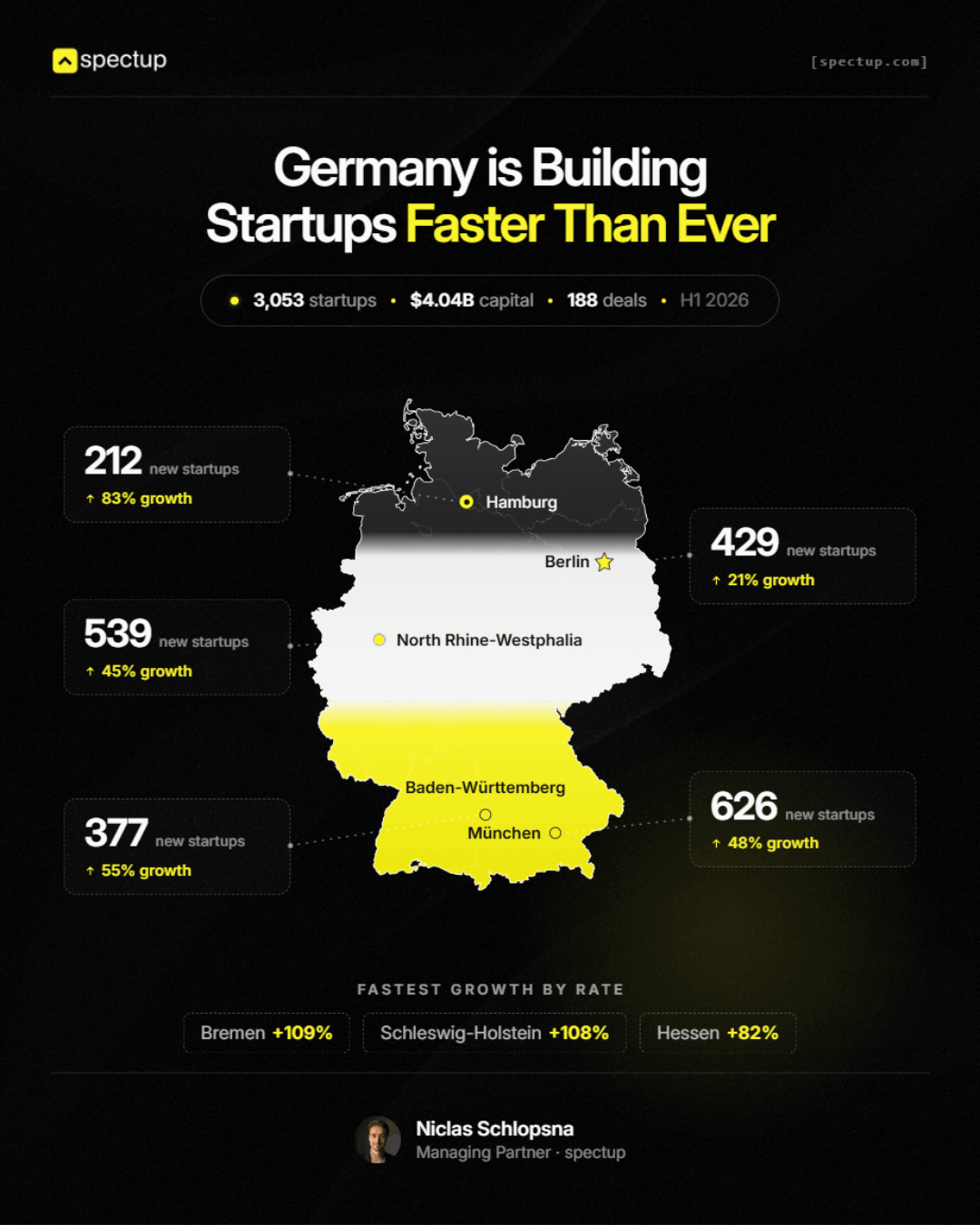
Germany is producing companies at record speed and writing bigger checks to fewer, later, safer bets. The record is not the story. The widening gap between what gets built and what gets funded is, and it is the thing nobody is really pricing in. My read: the bottleneck is not cash, it is investors with the conviction to back something before it is already consensus.
One more thing
Our second podcast episode is live. Deal Makers (& Fakers), episode 2, with Sam Tidswell-Norrish, Founder and Chair of OPUS and Partner at Access Holdings.
Sam was on the founding team of Motive Partners, the fintech PE firm now running close to $8 billion, and today he backs founders at day zero through OPUS. This one is epic. Go listen, and if it lands, send it to one founder who needs it.
& I have recorded another episode as well for the Podcast. It would be epic too!
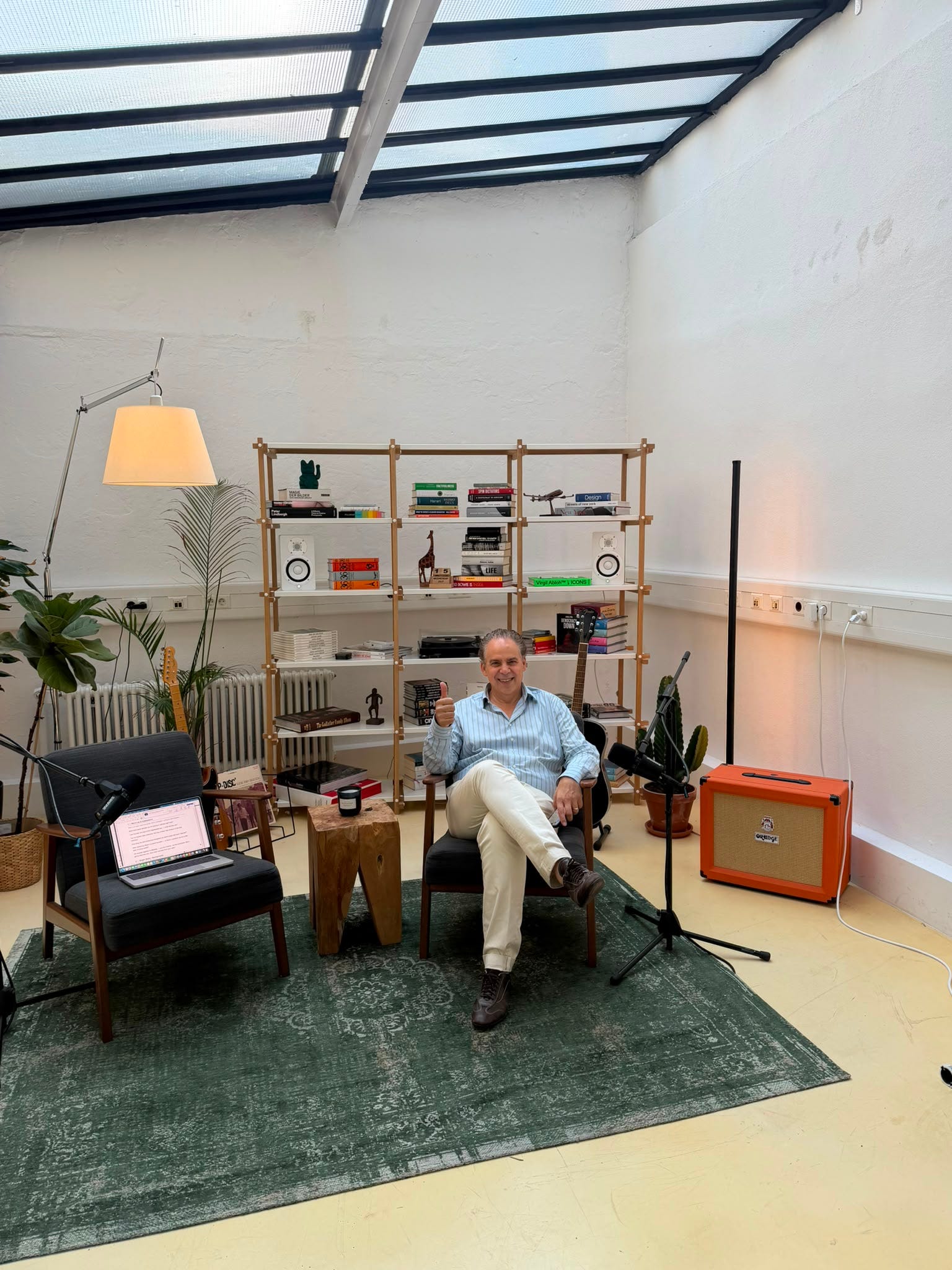
That is me for this week. Back to the inbox.
About spectup:
Capital advisory for companies raising from institutional investors (family office, VC, private equity) and for GPs raising a new fund and need intros to Limited partners